
240+
30+
IEC 62305
LPL I–IV
2024 edition — open area protection
Thunderstorm Warning System standard
Documented safety compliance records
Remote alerts & full event logging
Early warning before strike arrives
Lightning Protection System
Defending Structures from Direct Lightning Strikes
A Lightning Protection System (LPS) is an engineered system that intercepts direct lightning strikes and safely conducts the discharge current to earth, protecting a structure, its occupants, and internal equipment from fire, physical damage, and electrical failure. In Malaysia, all LPS must comply with MS IEC 62305.
Malaysia records over 240 thunderstorm days per year according to the Malaysian Meteorological Department (MetMalaysia) — among the highest lightning flash densities in the world. High-risk zones include the Klang Valley, Johor Bahru, and the Johor industrial corridors now hosting some of Southeast Asia’s largest hyperscale data centre developments. For data centres, industrial plants, government facilities, telecom towers, and high-rise buildings across Selangor, Kuala Lumpur, Johor, and Penang, a properly engineered LPS is not optional — it is a fundamental safety and regulatory compliance requirement.
In Malaysia, LPS design and installation must comply with MS IEC 62305, aligned with the international IEC 62305 series and BS EN 62305-2006, the standard adopted by JKR and recognised by SIRIM for all government and commercial projects.
Our system can support sirens, strobes, dashboards, notifications, escalation procedures and project-specific safe work protocols. The objective is simple: give teams enough warning to stop exposed work, move people to safety and resume operations with discipline once the risk has cleared.
Key Components
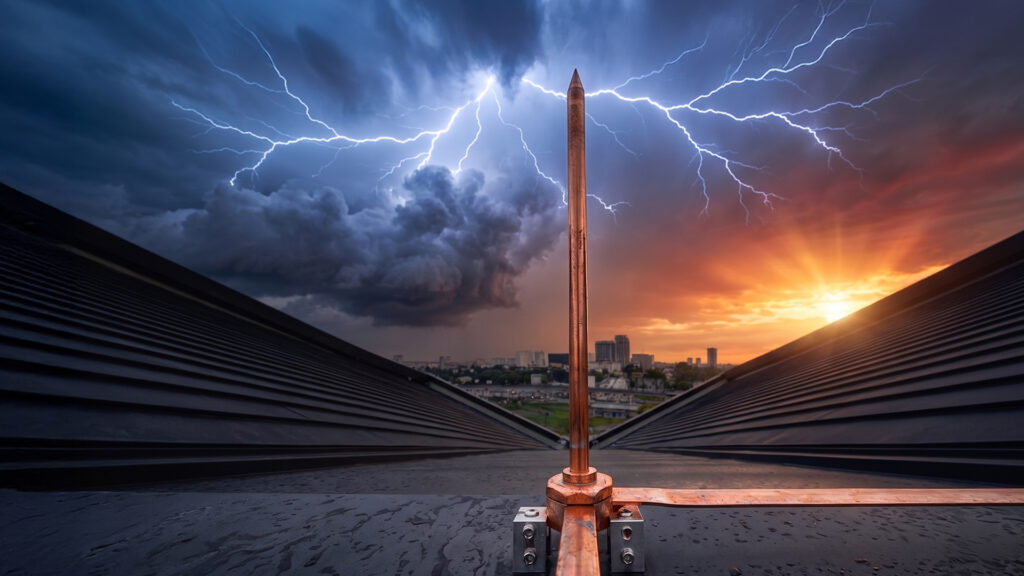
Air Terminal (Lightning Rod)
Installed at the highest point of the structure to intercept direct strikes before they reach unprotected parts of the building. Tokai supplies copper-alloy air terminals conforming to IEC 62561-1, positioned using the rolling sphere method or protective angle method as required by design.
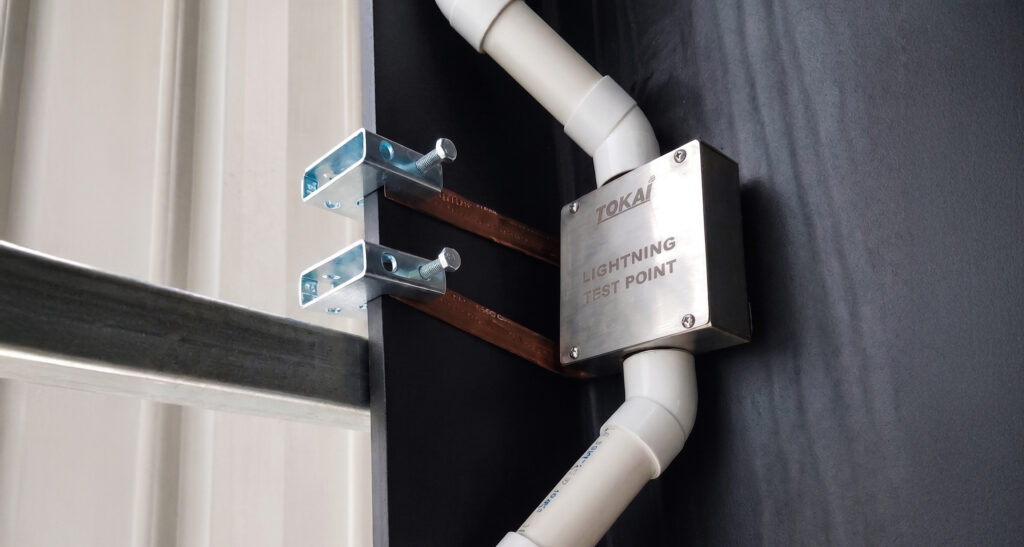
Down Conductors
A network of high-conductivity copper tape installed externally along the building facade, providing a low-impedance path for lightning current from the air terminal to the earth termination. Multiple parallel down conductors reduce the partial current in each conductor.
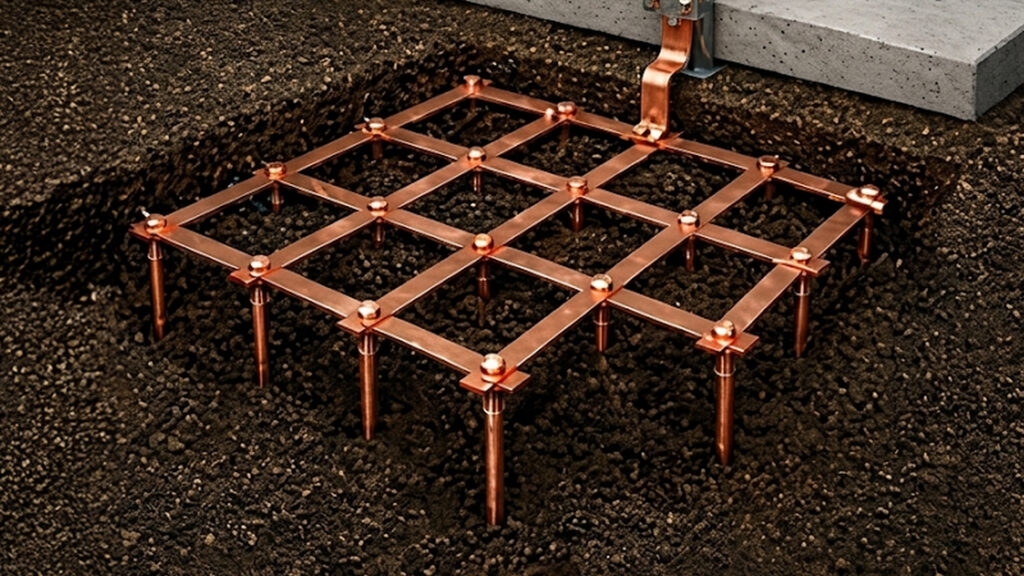
Earthing System
A low-resistance earthing network — using heavy-duty polymer earth chambers and copper-bonded earth rods — that safely dissipates lightning energy into the ground. Designs target resistance values per IEC 62305-3, validated by CDEGS modelling.
What We Deliver
Full Turnkey LPS Services
From initial risk assessment to final commissioning certificate — Tokai manages the entire lifecycle of your lightning protection system.
IEC 62305-2 quantitative risk assessment with CDEGS computational modelling. We determine the required protection level (LPL I–IV) and produce a stamped design package accepted by JKR and local authorities.
Certified air terminals, 25mm × 3mm copper tape, heavy-duty polymer earth chambers, bonding conductors, and test points — all traceable to the IEC 62561 series with full material certifications.
Full installation by trained technicians to MS IEC 62305 / JKR specifications. Works are documented throughout with photographic evidence and inspection hold points for consultant or authority review.
Continuity testing, earth resistance measurement, and full commissioning report per IEC 62305-3. Test certificates are issued in a format accepted for JKR, BOMBA, and consultant authority submission.
Scheduled post-installation inspections and maintenance to ensure ongoing compliance throughout the system lifecycle. Annual or biennial service programmes available per IEC 62305-3 inspection intervals.
As-built drawings, material traceability records, test certificates, and compliance documentation suitable for JKR, BOMBA, local authority, and international consultant review.
The Standard
Understanding IEC 62305
IEC 62305 is the international standard series for protection against lightning, adopted in Malaysia as MS IEC 62305. It comprises four parts covering general principles, risk assessment, physical protection of structures, and protection of internal electrical systems. All four parts must be considered together for complete lightning protection compliance.
All four parts work together to deliver complete protection — from structural design to internal electronics.
Lightning Protection Zones (IEC 62305-4)
LPZ 0A
Direct lightning exposure outside the structure
LPZ 0B
No direct strike Partial exposure inside
LPZ 1
Internal area Reduced surges
LPZ 2
Sensitive area Highest protection
Each zone transition requires appropriately rated SPDs.
Read the full IEC 62305 standard guide in our Resources section →
IEC 62305-2
Lightning Risk Assessment
A lightning risk assessment (IEC 62305-2) is a quantitative engineering analysis that determines whether a Lightning Protection System is required for a building and, if so, what Lightning Protection Level (LPL I–IV) is needed. It is mandatory for JKR projects, data centres, and all facilities where authority submission is required in Malaysia.
This is not a desktop exercise — it is a formal engineering analysis that considers your structure’s characteristics, occupancy, location, and the consequences of a lightning strike.
For JKR projects, hyperscale data centre developments in Johor Bahru and Selangor, solar farms in Johor and Perak, and any facility where a professional engineer’s endorsement is required, the IEC 62305-2 risk assessment forms the authoritative basis for the LPS design brief. Malaysia’s ground flash density (Ng) varies by state — Johor Bahru, the Klang Valley, and Penang Island typically record among the highest values, directly influencing the risk calculation outcome (Source: MetMalaysia / TNB lightning data networks).
Site Data Collection
Structural dimensions, occupancy type, location (Ng), service lines, and loss consequence categories
Threat Identification
Classify all lightning strike types: to structure, near structure, to service lines, and near service lines
Risk Calculation
Compute risk components R1–R4 against tolerable risk thresholds RT per IEC 62305-2 methodology
LPL Determination
Determine required Lightning Protection Level (LPL I through IV) where R exceeds RT
Design Brief Issued
Stamped risk assessment report with LPL recommendation, forming the brief for detailed LPS design
- Ground flash density (Ng) and annual strike frequency analysis
- Structure classification and consequence of loss assessment
- Risk component calculation: R1 (injury), R2 (physical damage), R3 (failure of internal systems), R4 (economic loss)
- Tolerable risk (RT) comparison per IEC 62305-2 Annex D
- LPL I–IV determination with supporting justification
- Preliminary SPDcoordination requirements (IEC 62305-4)
- CDEGS computational earthing modelling (where required)
- Stamped IEC 62305-2 Risk Assessment Report
- Lightning Protection Level (LPL) determination certificate
- Conceptual LPS design layout drawings
- SPD coordination recommendations per IEC 62305-4
- Earthing resistance target values (per IEC 62305-3)
- Material specification schedule (IEC 62561 series)
- Documentation package for JKR / authority submission
Lightning Protection Levels (LPL I–IV)
The LPL determines the rolling sphere radius, mesh size, down conductor spacing, and air termination design. Higher risk structures require more stringent (lower numbered) protection levels.
IEC 62305-2
Ready for a Formal Risk Assessment?
- Site survey and detector placement optimisation
- System design tailored to site footprint and workforce size
- Full supply, installation, testing, and commissioning
- Operator and safety officer training
- Maintenance contracts and annual service available
- Tokai Engineering (M) Sdn Bhd
- MS IEC 62305 · IEC 62793 · JKR · SIRIM
IEC 62305:2024 Edition
Built for OSHE and Operational Control
In high-risk environments, the question is not whether lightning will occur – it is whether the site will have enough warning to respond correctly. A lightning warning system gives project teams a structured way to manage stop-work decisions, evacuation, sheltering, all-clear timing and activity resumption.
Tokai helps convert weather uncertainty into an operational protocol. This strengthens safety culture, reduces subjective decision-making and supports a more defensible approach to lightning risk management.
Core System Components
Sectors Served
Typical Applications
Why Choose Tokai Lightning Warning System?
Tokai brings practical site experience in lightning risk, earthing, surge protection, OSHE requirements and critical infrastructure delivery. We understand that warning systems must be simple enough for site teams to follow, robust enough for harsh environments and credible enough for management decision-making.
From deployment planning to alert response training, Tokai helps organisations build a lightning safety workflow that works in the real world, not just on paper.
Real-time lightning threat monitoring for exposed sites and operational facilities
Early warning alerts to support timely suspension of high-risk outdoor activities
Configurable alert zones, escalation levels and response procedures
Integration with siren, strobe, dashboard and notification workflows
Supports occupational safety, project governance and incident prevention
Useful for temporary construction deployments and permanent facility installations
Complements lightning protection, earthing and surge protection systems
Supports documented safety response and operational accountability
FAQ
Common Questions About Lightning Protection Systems
Understanding Lightning Protection System, standards compliance, and Tokai’s services.
Is a Lightning Protection System (LPS) mandatory in Malaysia?
For certain building classes — including high-rise buildings, government structures, and facilities storing hazardous materials — LPS installation is required under JKR specifications and local authority requirements. For other buildings, an IEC 62305-2 risk assessment formally determines whether an LPS is warranted. Tokai can conduct this assessment and provide a stamped engineering report.
What is the difference between IEC 62305-3 and IEC 62305-4?
IEC 62305-3 covers the external LPS — air terminals, down conductors, and earthing systems that protect the physical structure from direct strikes. IEC 62305-4 covers internal protection — surge protection devices (SPDs), equipotential bonding, and electromagnetic shielding to protect electronic and electrical equipment from lightning electromagnetic pulse (LEMP). Both are typically required for data centres and critical infrastructure.
How often does an Lightning Protection System need to be inspected?
IEC 62305-3 recommends periodic inspection at intervals not exceeding one year for LPL I and II systems, and two years for LPL III and IV. Following any nearby direct lightning strike or structural modification to the protected structure, an additional visual and electrical inspection is recommended. Tokai offers annual service contracts covering inspection, testing, and report issuance.
Can Tokai handle the entire process from design to certification?
Yes. Tokai is a full turnkey LPS provider. We cover: IEC 62305-2 risk assessment and LPL determination, detailed LPS design drawings, material supply (IEC 62561-compliant), installation by trained technicians, testing and commissioning per IEC 62305-3, and full documentation for authority submission. A single point of accountability from brief to certificate.
What is the difference between an LPS and a surge protection system?
An LPS (external system per IEC 62305-3) handles direct lightning strikes to the structure — intercepting the discharge and routing it safely to earth. A Surge Protection System (internal, per IEC 62305-4) handles transient overvoltages on electrical and data lines caused by nearby strikes and induction. Both are required for complete protection of a facility and its equipment.
What is the IEC 62305:2024 update and how does it affect my project?
The 2024 edition of IEC 62305 places significantly greater emphasis on protecting people in open areas — not just buildings and equipment. It formally recognises Lightning Warning Systems (LWS/TWS) compliant with IEC 62793 as a required preventive measure for sites with outdoor personnel exposure. For construction projects, solar farms, and industrial facilities with outdoor workers, this means a Lightning Warning System is now part of the overall lightning risk management programme.
Is lightning protection mandatory for data centres in Malaysia?
Yes. Data centres in Malaysia are classified as critical infrastructure with high consequence of loss under the IEC 62305-2 risk methodology. This typically results in LPL I or LPL II — the most stringent protection levels — being required. Compliance with MS IEC 62305 is expected for Tier III/IV certification reviews, international consultant sign-off, hyperscaler occupancy requirements, and JKR submission for government-linked projects. Tokai provides full IEC 62305-2 risk assessments and turnkey LPS programmes for data centres of all scales across Malaysia.
What is the difference between a conventional LPS and an ESE lightning rod?
A conventional LPS uses passive air terminals positioned by the rolling sphere method or protective angle method, as defined in IEC 62305-3. An ESE (Early Streamer Emission) rod claims to extend its protective radius by triggering an upward leader earlier than a standard terminal. However, IEC 62305 — the international standard for lightning protection and the basis of MS IEC 62305 in Malaysia — does not recognise ESE terminals. Protection radius claims for ESE rods are not supported by IEC 62305-3 methodology. Tokai’s designs use conventional air terminals fully compliant with IEC 62305-3 and IEC 62561-1, accepted by JKR and SIRIM.
How much does a lightning protection system cost in Malaysia?
LPS cost varies based on structure size, required Lightning Protection Level (LPL I–IV), number of air terminals and down conductor runs, earthing system complexity, and whether commissioning reports are required for authority submission. A small commercial building may involve a straightforward installation, while a hyperscale data centre or large industrial facility requires a formal IEC 62305-2 risk assessment and detailed design before accurate pricing can be provided.
Complete Protection
Related Services
Lightning protection is one layer of a complete protection strategy. These services work together under the IEC 62305 framework.
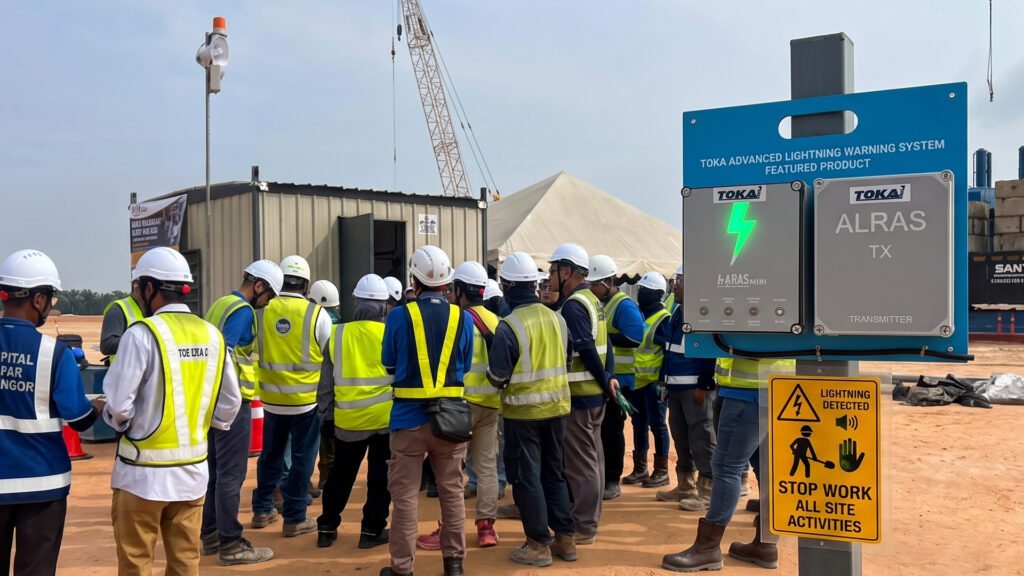
Take appropriate measures to protect your facilities today
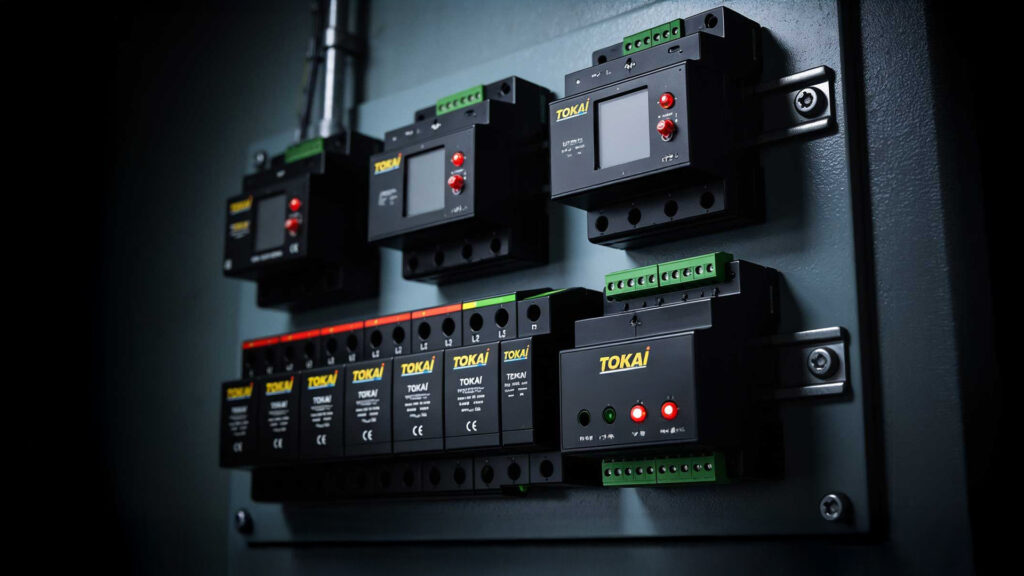
The Tokai Lightning Warning System gives organisations the one resource they need most during a lightning threat: time. Time to stop work, protect people, secure operations and resume safely with confidence.